
How Does The Genius Switch Work? The Science Behind Its Brainwave Audio
How does The Genius Switch work? Explore its brainwave audio, binaural beats, 40 Hz gamma waves, brainwave entrainment, and the science behind it.
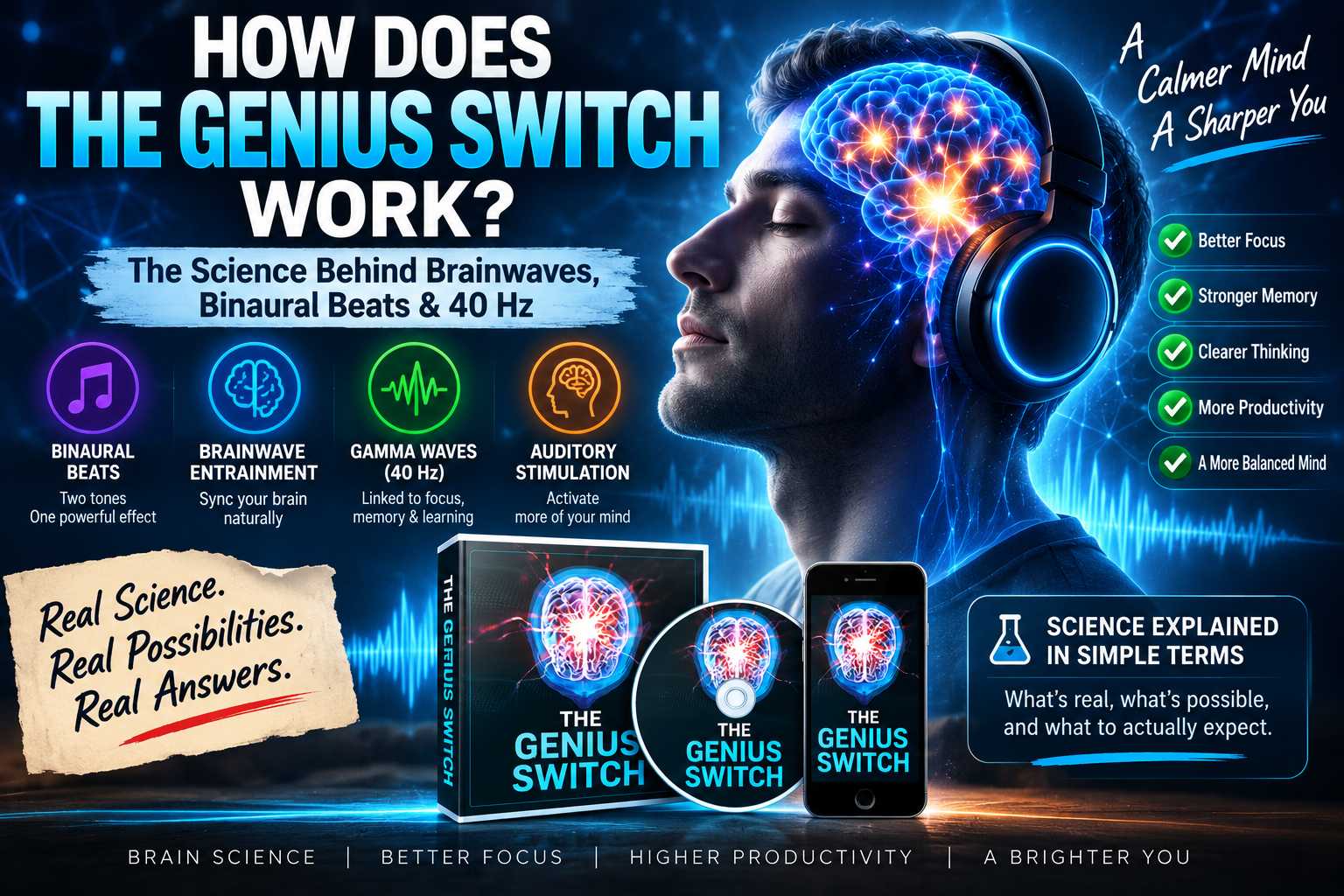
The Genius Switch is a digital audio program built around the idea that sound can influence brain activity in a way that supports focus and mental clarity. If you're trying to understand how does The Genius Switch work before you consider buying it, the short answer is: it uses audio techniques associated with brainwave entrainment, specifically referencing gamma-frequency activity around 40 Hz. Whether that mechanism actually does what the marketing implies is a more complicated question, and it's the one this article is built to answer.
This isn't a review of whether the product is worth your money or whether it's trustworthy as a purchase. That ground is covered separately. This article stays specifically on the mechanism: what the product claims to do, what the underlying neuroscience actually shows, and where the gap sits between the two.
How Does The Genius Switch Work?
Based on the official product page, The Genius Switch is a daily audio track designed to be listened to through headphones. The sales materials describe the audio as using specific sound frequencies intended to stimulate gamma brainwave activity, and the page includes an extensive reference list citing published research on brain-derived neurotrophic factor (BDNF), gamma oscillations, and binaural beats as the scientific basis for the approach.
The core claimed mechanism is straightforward to describe even if the underlying neuroscience is more complex: rhythmic audio stimulation is used with the goal of nudging the brain's electrical activity toward a gamma frequency pattern, a state some research associates with attention and cognitive processing. That's the claim. What follows breaks down each piece of that claim on its own terms.
👉 Check The Genius Switch Offer
What Is The Genius Switch?
Briefly, The Genius Switch is a downloadable digital audio product, not a supplement, device, or app with ongoing features. It's a single track or short series intended for daily listening, sold as a one-time digital purchase. For details on pricing, refund policy, and what's included in the purchase, that ground is covered in our other coverage of the product rather than here, since this article is focused specifically on the audio mechanism itself.
Does The Genius Switch Use Binaural Beats?
The product's own reference list includes at least one study specifically on binaural beats (Ross & Lopez, 2020, on 40 Hz binaural beats and attentional blink), which strongly suggests binaural beats are part of the audio design, even though the sales page doesn't always spell out the exact audio engineering in plain terms. Some independent commentary on the product also describes it using binaural-beat and isochronic-tone techniques together. Because the precise technical composition of the audio isn't fully disclosed on the official page beyond referencing gamma stimulation, it's more accurate to say the product appears to incorporate binaural-beat-style techniques as part of a broader gamma-frequency audio approach, rather than to claim a single, precisely documented method.
What Are Binaural Beats?
Binaural beats are an auditory illusion. When you listen through stereo headphones and each ear receives a slightly different pure tone frequency, for example 200 Hz in one ear and 210 Hz in the other, your brain perceives a third, phantom "beat" at the difference between those two frequencies, in this example 10 Hz. That perceived beat isn't actually present in the audio; it's generated by your auditory processing system combining the two slightly mismatched tones.
Researchers have studied binaural beats for decades because the frequency of that perceived beat can be tuned to match different brainwave bands, like alpha, theta, or gamma, based on the idea that the brain's electrical activity might shift to align with the beat frequency it's perceiving. Some studies have found modest effects on measures like sustained attention or subjective calm. Other studies have found no significant effect compared to a control condition. The research isn't uniformly positive, and effects that are found tend to be small and inconsistent across different study designs, listening conditions, and populations tested.
What Is Brainwave Entrainment?
Brainwave entrainment is the broader concept that binaural beats are one example of: the idea that a rhythmic external stimulus, whether it's sound, light, or another sensory input, can cause the brain's own electrical oscillations, as measured by EEG, to synchronize with the rhythm of that stimulus.
This isn't a fringe concept. EEG researchers do observe that rhythmic sensory input can produce corresponding rhythmic patterns in recorded brain activity under controlled lab conditions. Where the science gets murkier is in translating that lab-measured phenomenon into a reliable, meaningful real-world outcome, like sustained improved focus or better memory, from a home listening session. Entrainment as an EEG-measurable phenomenon and entrainment as a guaranteed cognitive-enhancement tool are not the same claim, and research to date supports the former far more consistently than the latter.
👉 Check The Genius Switch Offer
What Are Gamma Waves?
Gamma waves are a band of brain electrical activity generally described as ranging from around 30 Hz up to 100 Hz, though different sources define the exact boundaries slightly differently. In EEG research, gamma activity is often observed during periods of active concentration, sensory processing, and working memory tasks, which is why it's become a frequency of particular interest to researchers studying attention and cognition.
It's important to be precise about what that association means. Researchers observing more gamma activity during a cognitive task doesn't automatically mean that artificially generating gamma-frequency stimulation from the outside will produce the same cognitive benefits the brain shows when it naturally generates that activity during real engagement with a task. Correlation between a brain state and a cognitive process is a different claim than causation running the other direction, from an external audio cue back to improved cognition.
What Is 40 Hz Gamma Stimulation?
40 Hz specifically has drawn significant research interest within the gamma range, partly because of animal studies exploring whether externally applied 40 Hz sensory stimulation, light, sound, or both, could influence markers associated with neurological health. One widely cited study published in the journal Cell (Martorell et al., 2019) found that multi-sensory 40 Hz light and sound stimulation reduced markers of Alzheimer's-associated pathology and improved certain cognitive measures in mice.
That's a genuinely notable finding, and it's part of why 40 Hz shows up so often in brain-health marketing. But it's a study conducted in mice, using a specific, controlled laboratory stimulation protocol, measuring specific biological markers, not a study of human listeners using a consumer MP3 through everyday headphones. Extending a mouse study's findings to a commercial human audio product requires a chain of assumptions that hasn't been independently tested. That gap is one of the most commonly overstated pieces of this entire category of product.
The Genius Switch And 40 Hz: What Is Actually Known?
Here's where the product claim and the scientific evidence need to be pulled apart cleanly. The product claim is that its audio delivers 40 Hz gamma stimulation intended to support memory, focus, and cognitive function, and the sales page supports that framing by citing research on gamma oscillations, BDNF, and 40 Hz stimulation, including the mouse study referenced above and other citations on brainwave and BDNF research.
The scientific evidence is that 40 Hz gamma stimulation has been studied in specific experimental contexts, mostly animal research and some human EEG studies, with promising but preliminary findings that have not been replicated at scale in humans using consumer audio delivery. No independent, peer-reviewed clinical trial testing The Genius Switch itself, its exact audio composition, delivered to human participants, and measuring a defined outcome, appears to exist. The product's own citation list supports the plausibility of the underlying mechanism being worth studying. It does not include a study of the product itself.
What Does The Science Say About Binaural Beats?
Pulling together the broader research picture rather than product-specific claims: some studies have found binaural beats can produce small improvements in sustained attention or reductions in state anxiety under certain listening conditions. Other studies, including some systematic reviews, have found effects that don't reach statistical significance or don't replicate consistently across different labs and populations. Memory-specific findings are even less consistent than attention findings.
The most accurate general summary is that binaural beats research shows some evidence of modest effects for some outcomes in some studies, not a settled, replicated finding that binaural beats reliably produce a specific cognitive benefit for all listeners. That mixed picture is normal for a research area that's still relatively young and methodologically varied, and it's a meaningfully different picture than "binaural beats are proven to boost focus," which is the kind of claim marketing for these products tends to compress the science into.
👉 Check The Genius Switch Offer
Does Brainwave Entrainment Really Work?
As a measurable EEG phenomenon, yes, in the sense that rhythmic sensory stimulation can produce corresponding rhythmic patterns in recorded brain activity under lab conditions. As a reliable tool for producing a specific, desired cognitive outcome in a general consumer using a home audio track, the evidence is considerably weaker and less consistent. The honest answer sits between "it's pseudoscience" and "it's proven," which is an uncomfortable middle ground for marketing copy but an accurate one for the current state of research.
Can Binaural Beats Improve Focus?
Some research suggests they may, for some people, under some conditions, to a modest degree. That's a real finding, but it's also a heavily qualified one. It doesn't mean binaural beats reliably improve focus for everyone who listens, and it doesn't mean any specific commercial product built around binaural beats has demonstrated that effect for its own listeners.
Do Binaural Beats Actually Work?
The evidence doesn't support treating this as a solved yes-or-no question. Some studies show an effect; others don't. The honest framing is that binaural beats have shown modest, inconsistent effects across the existing research, which is different from either "they don't work at all" or "they're scientifically proven to work."
Does The Genius Switch Improve Memory?
There's no independent evidence establishing that this specific product improves memory. The product's citation list references general BDNF and memory research, since BDNF is genuinely linked to memory consolidation in neuroscience literature, but none of the cited studies test whether listening to this audio track changes memory performance in human participants. Extending general BDNF research to a specific memory claim for this product isn't supported by direct evidence.
Is The Genius Switch Scientifically Proven?
This deserves a precise answer, because "scientifically proven" is a specific claim, not a marketing flourish. For a product to be considered scientifically proven, there would typically need to be independent, peer-reviewed research testing that exact product, with defined outcome measures, a control condition, and results that have been replicated or at least published in a credible journal.
That kind of evidence does not exist for The Genius Switch specifically. What exists is a citation list referencing legitimate research into the general mechanisms the product claims to use, gamma oscillations, BDNF, and binaural beats. That's meaningfully different from proof. The product is built on scientifically plausible concepts. It has not been scientifically proven to work as advertised.
The Genius Switch Scientific Evidence: What We Found
| Evidence Category | What Exists |
|---|---|
| General mechanism (brainwave entrainment) | Established as a measurable EEG phenomenon; real-world cognitive benefit less consistently supported |
| Binaural beats research | Some studies show modest effects on attention/anxiety; findings are mixed, not uniform |
| Gamma/40 Hz stimulation research | Some notable findings, largely in animal studies; human translation still developing |
| Evidence specifically testing The Genius Switch | None found; no independent clinical trial identified |
| Product-specific claims (memory, focus, "unlocked potential") | Not independently verified; extrapolated from general research, not product testing |
What The Research Can And Cannot Tell You
The research can tell you that gamma-frequency brain activity is genuinely associated with attention and cognitive processing, and that externally applied rhythmic auditory stimulation is a real, studied phenomenon with some documented effects. What it cannot tell you is whether this specific audio product, played through your specific headphones in your specific environment, produces a reliable, measurable improvement in your own cognition. That's the difference between "scientifically plausible" and "clinically proven," and it's a distinction worth holding onto whenever a wellness or cognitive product cites real neuroscience in its marketing.
Who Might Be Interested In The Genius Switch?
People who are already curious about binaural beats or ambient focus audio, comfortable treating the product as a personal experiment rather than a clinically validated intervention, and interested in a low-effort daily listening routine are the most natural fit for this kind of product based on its intended design and use case.
👉 Check The Genius Switch Offer ��
What Should You Expect From The Genius Switch?
Based on the state of the underlying research, a realistic expectation is a possible subjective sense of focus or calm during or shortly after listening, similar to what's reported anecdotally with other ambient or binaural audio tools, rather than a guaranteed, measurable cognitive upgrade. It would not be reasonable to expect a higher IQ, permanent changes to brain structure, treatment of a diagnosed cognitive or neurological condition, or a scientifically guaranteed improvement in memory or focus, since none of those outcomes are supported by direct evidence for this specific product.
FAQ
How does The Genius Switch work?
It's a daily audio program that uses techniques associated with brainwave entrainment, referencing gamma-frequency (around 40 Hz) stimulation, based on the idea that rhythmic sound can influence brainwave activity linked to attention and focus.
What is The Genius Switch?
A digital audio product, a downloadable track or short series intended for daily headphone listening, sold as a one-time digital purchase.
What are binaural beats?
An auditory effect created when two slightly different tone frequencies are played separately into each ear through stereo headphones, causing the brain to perceive a third "beat" frequency equal to the difference between the two tones.
Does The Genius Switch use binaural beats?
The product's cited research references binaural beats, and independent commentary describes binaural-style audio techniques as part of its design, though the official page doesn't fully spell out the exact technical composition.
Does The Genius Switch use gamma waves?
The product is marketed around stimulating gamma-frequency brain activity, referencing research on gamma oscillations as its scientific basis.
What is 40 Hz gamma frequency?
A specific frequency within the gamma brainwave band that has drawn research interest, including animal studies on sensory stimulation and neurological markers, though human evidence is still developing.
Is The Genius Switch scientifically proven?
No independent clinical trial testing this specific product could be found. It's built on scientifically plausible concepts, which is different from being independently proven effective.
Is there scientific evidence for The Genius Switch?
There's scientific evidence for the general mechanisms it references, gamma oscillations, binaural beats, and BDNF, but no direct evidence testing this specific audio product.
Does brainwave entrainment really work?
As a measurable EEG phenomenon, yes, in lab conditions. As a reliable driver of a specific cognitive outcome for a general listener at home, the evidence is mixed and less conclusive.
Can binaural beats improve focus?
Some research suggests modest effects for some listeners under certain conditions, but this isn't a consistent or universal finding across all studies.
Do binaural beats actually work?
The research shows mixed results: some studies find modest effects, others find none. It's not accurate to call the effect either definitively proven or definitively absent.
Does The Genius Switch improve memory?
No independent evidence establishes that this specific product improves memory. Its marketing draws on general BDNF and memory research, not testing of the product itself.
Updated 2 months ago